 Feronerie & Configurator
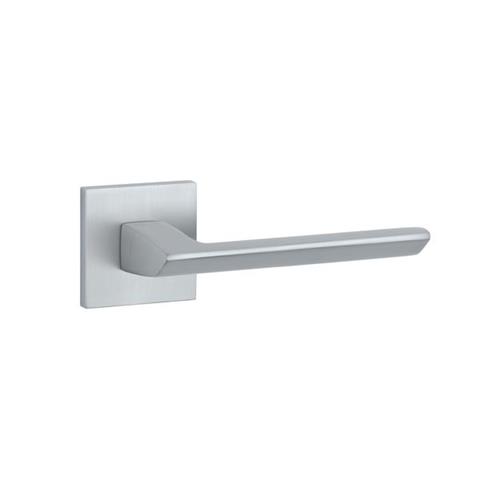
The centre distance is the distance between the centre of the handle spindle and the centre of the locking axis. The standard used in Romania for interior doors is 90mm.
How to check: Use a ruler to measure the distance between the centre of the handle hole and the centre of the locking hole in the door.
It depends on the recess machined into the door. Read the complete guide to SLIM rosettes
The centre distance (PZ — from the German Profilzylinder-Abstand) is the distance between the centre of the locking cylinder and the centre of the handle spindle. It determines whether the handle will fit the lock in your door.
| Standard | Centre distance | Use |
|---|---|---|
| European standard | 72mm | The most common in Romania, interior and exterior doors |
| Small standard | 62mm | Older doors, some bathroom doors |
| Large standard | 92mm | Armoured exterior doors, industrial doors |
The spindle (shaft) of the handle passes through the door and connects the front handle to the back one. The spindle length must match the thickness of your door.
| Door thickness | Required spindle length | Door type |
|---|---|---|
| 35-40mm | 70-75mm | Budget standard interior doors |
| 40-45mm | 75-80mm | Standard interior doors in Romania |
| 45-50mm | 80-85mm | Premium interior doors, solid wood |
| 50-60mm | 85-95mm | Basic exterior doors, thermally insulated |
| 70-100mm | 110-130mm | Armoured, high-security doors |
Enger handles are supplied with a standard 80mm spindle, compatible with doors 40-45mm thick. For thicker doors, the spindle is ordered separately in the correct length.
A rosette has several relevant dimensions: an outer diameter of 52-55mm for standard round rosettes; 52x52mm for square rosettes; a cylinder opening diameter of 28-30mm (compatible with standard European cylinders); a profile thickness of 5mm or 7mm (SLIM) or 12-15mm (classic); and a standard 8mm handle spindle opening (square).
The locking cylinder must be proportioned to the thickness of the door. A cylinder that is too short will not seat correctly; one that is too long protrudes from the rosette and is vulnerable to snap attacks.
| Door thickness | Recommended cylinder | Format |
|---|---|---|
| 40mm | 30+10mm | 40mm cylinder overall |
| 45mm | 30+15mm | 45mm cylinder overall |
| 55mm | 30+25mm | 55mm cylinder overall |
| 65mm | 30+35mm | 65mm cylinder overall |
Safety rule: the cylinder must not protrude more than 3mm beyond the surface of the rosette. A cylinder that sticks out too far can be wrenched off with an adjustable spanner (snap attack).
The door lock (the internal mechanism) must be compatible with the handle. The key parameters: a backset of 60mm or 70mm — the distance from the edge of the door to the centre of the handle spindle; a faceplate height of 235mm (European standard); a standard 8mm square spindle (the handle mounts on an 8mm square shaft); and a latch throw of 13mm or 18mm.
(1) Measure the PZ centre distance — from the centre of the cylinder hole to the centre of the handle spindle hole. Use a metal ruler. Typical result: 72mm. (2) Measure the door thickness — with the door open, measure the total thickness of the panel. Add 5mm to determine the required spindle length. (3) Check the lock backset — from the edge of the door to the centre of the handle spindle. 60mm or 70mm are the standard values. (4) Photograph your current cylinder — if you are replacing a cylinder, photograph it with a ruler next to it. The length and format must stay identical. (5) Not sure? Send us photos and your measurements and we will help you identify compatible products — free of charge.
The LC Design team will help you choose the right handle for your door — free of charge, no strings attached.